Chapter 6: Army Life
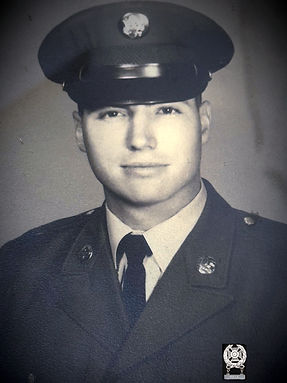
I was sent to Fort Dix in New Jersey for Army Basic Combat Training (commonly called "Boot Camp") and Advanced Infantry Training. Both were challenging on their own; however, the dead of winter made them even more difficult. I recall being out at the machine-gun shooting range in the snow, where we were required to pick up all the spent shells from the packed snow. It could not be done with gloves on because, once the bullet was fired and the hot shell ejected, it would land on the packed snow, where it would melt and refreeze. Therefore, gloves had to be removed to pick the shells out of the frozen, packed snow.
The Drill Sergeants were some of my favourite characters. They were loud, commanding, and polished. Some of them could make a living as stand-up comedians. I realised that in a way, they were there to instruct and entertain a captive audience. I was impressed at the idea that these men were merely actors interacting with a new audience every eight weeks.
My grandfather and my father were excellent marksmen, honed by years of hunting game in the mountains to ensure their survival. They taught me at an early age to hit the target. Part of Army training is to be proficient with a rifle. They actually give you a medal to wear on your uniform, showing just how good you are with a rifle. During the Vietnam War era, most soldiers qualified as Marksmen or Sharpshooters. Expert shooters were rare. On the day we were to qualify on the shooting range, it was early morning, and the sergeant announced that anyone who qualified as an Expert would be given leave for the weekend. I was excited because we were going alphabetically, which meant that I was first up. But when I stepped up to the sergeant, he said I would be handing out the ammunition. So, for the next four to five hours, I listened to the rifles being fired close to me and breathed in all the smoke, such that by the time it was my turn, I had an awful headache, and I was angry about my bad luck. The qualifications involved walking down a long, high path overlooking a lot of surrounding foliage, where targets would appear randomly for only a few seconds before vanishing back
into the foliage. Most who took the test would either miss the target or be unable to fire before it vanished. As I began walking down the path, I successfully took down each target that appeared. The operator in the tower stopped me over a loudspeaker before I reached the end of the path. I had already scored Expert. That night, I called Becky and told her I was on leave for the weekend. She bought a bus ticket, and we had a memorable weekend together.
It was during the Advanced Infantry training that I bought an engagement ring for Becky. On a short leave while riding horses at my grandfather's, I presented Rebecca with the engagement ring in the hayloft next to the horses. When we shared the news with my grandmother, the part about the hayloft caused her eyes to widen. Covering her mouth, she said, “Oh my!” Obviously, it meant something different in her day. My grandfather, however, went into the house and brought back a circular wooden disk
with an Indian chief engraved on it, which had been hanging on his wall for as long as I could remember. He explained that, as the eldest heir to the Allisons’ name,
he wanted to pass on this family heirloom to me. What made this moment so surreal is that Becky's mother had given her the same kind of heirloom, except it was of an Indian Princess. It was as if Providence was telling us we were meant to be together. They have both hung together to this day.
After completing my training in the frigid coldness of the North, I was sent to Fort Benning in the hot and humid swamps of Columbus, Georgia, for Officer Candidate School (OCS). Here, instead of Drill Sergeants, we had Tac Officers. Unlike the entertaining character of Drill Sergeants, Tac Officers are there to stress you out with unrelenting harassment at a crushing pace. After a few months, some men quit out of sheer mental fatigue, even knowing they would quickly be shipped off to Vietnam. One thing I learned from my college failings was that quitting was not an option.
This was similar to role-playing in my acting classes, where the professor would design a scenario and assign a specific character type to interact with another. These improvised exercises would help develop the ability to quickly craft responses that align with a particular character’s personality.
I realised early on that I needed to adopt the character traits of a man who was imperious to emotional control by others. No matter what they said, no matter how many push-ups I had to do, no matter how far I had to low crawl on my spit-shined boots, I would look straight ahead without a hint of emotion and respond with “Yes, Sir” or “No, Sir”!
Not only did I not let their continuous harassment mire me down. I let them know I could handle all that and more by volunteering for activities others avoided. When a call went out for volunteers to audition for the OCS choir, I stepped up and offered my free time to sing at events and even on TV. When they wanted someone to paint a mural inside the barracks, I volunteered, even though I wasn't an artist. I knew how to paint sets for the stage by filling a picture with squares and then transferring each square onto the canvas flats, or in this case, a concrete block wall. When they wanted someone to volunteer to play a drum while marching, I stepped up again, even though marching for miles with a backpack and a rifle was hard enough without the weight of a large marching band drum. Years before, I had a dream so memorable it felt like a memory from a past life. The dream involved looking down at a drum being played with drumsticks, then slowly lifting my gaze to a flag with 13 stars arranged in a circle.
My TAC officer gave me good reports saying I would make a fine officer. Three-fourths of the way through OCS, my TAC officer threw a beer party for us off base, where we all had a few beers. As he was driving back on base, the MPs stopped him, and he was charged with driving on base intoxicated. He lost his position as a TAC officer, and a new TAC officer was assigned to our platoon. He went through our files and interviewed each of us. At my interview, I sensed an attitude in him: a strong aversion to anyone he could not identify with. He read my file with an air of disdain, noting my degree in drama, my position in the choir, my mural, and my drum playing, as if these were not the things becoming of an officer.
It was not a total surprise to me that, on the day before graduation, he told me I would not be graduating with the rest of the class. Staying in character, I showed no emotion and said “Yes, Sir” and saluted. Had he not blocked my graduation, I would have served an additional year in the Army and would have been sent to Vietnam. In retrospect, it was the best thing that ever happened to me.
As it turned out, I secured a position as a typist processing forms. I was given a private room in a dormitory and worked 8 to 5, with nights & weekends off. Having completed Basic, Advanced Infantry, and OCS, passing all tests in weaponry and hand-to-hand combat, I considered myself one of the most lethal typists in the armed forces.
In the Army, you could get up to three months early out if you were accepted into a university. My research into universities offering master’s degrees in theatre revealed only one that began its program three months before my release. Based on that alone, I applied to the University of North Carolina at Greensboro.
During my time as a lethal typist, I became involved with the Springer Opera House Community Theatre, where I participated in several productions and received a letter of recommendation from the director to the University of North Carolina at Greensboro.

Departing for duty, such sweet sorrow.

Cold & wet in northern winter.
Not meant to be a pleasant place for boot camp!

The day I gave Rebecca an engagement ring in the hay loft.
Click to view gallery


Family Heirlooms
Click to view gallery


My parents visited me at OCS, fearing that once I finished training, I would be sent to the war front.
The beer party that may have saved my life!

My friend and I played foosball with such skill that we would make bets for Cokes & candy that we could get 10 goals before our opponents could score one goal. We never had to buy Cokes or candy from the vending machines.

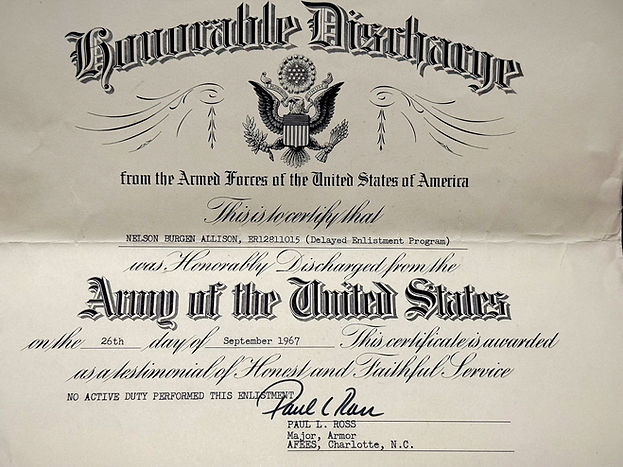
Mistakes are not uncommon in the Army. On my discharge certificate, they have the date I entered the service rather than the date of discharge.